


A certificate of analysis can look official and still leave you with questions. Here is how to read the names, numbers, peaks and fine print without confusing one test result for the whole quality picture.

A COA Looks Official but What Does It Actually Tell You
In our first peptide guide, we sorted the category into four very different lanes: naturally occurring peptides, approved medicines, food and cosmetic peptides, and investigational research compounds. The next logical question is about the document people wave around when they want to prove quality: the certificate of analysis, usually shortened to COA.
A COA is a laboratory report tied to a particular sample. Depending on the laboratory and the work ordered, it may identify the material, estimate purity, measure the amount present, or report other characteristics. That can be useful information. It is not, however, a universal seal of approval. A single page cannot automatically establish safety, sterility, effectiveness, regulatory status, or even that the tested sample came from every item carrying the same label.
The smart way to read a COA is not to hunt for the biggest percentage. Start with the chain of questions: What was tested? Which lot was tested? What method was used? What did that method actually measure? Who performed the test? And what important questions remain unanswered?

Start With the Identity Block
Before looking at a graph, confirm that the basic information matches the material being discussed. A useful report should identify the sample, laboratory, report or test number, date, and preferably a lot or batch number. The product name on the COA should agree with the product name and lot on the associated documentation.
Small mismatches deserve attention. A missing lot number, a different abbreviation, an unexplained dosage, or a report date that predates the stated batch can break the connection between the document and the material. It may be an innocent paperwork error, but it still needs an explanation. Traceability is the point.
· Sample or compound name that matches the associated record
· Lot or batch number that matches the material being represented
· Laboratory name and contact information
· Date received, date tested or report date
· Test method and a clearly stated result
· A report number, signature or another way to verify the record
Purity Identity and Quantity Are Different Questions
These terms are often bundled together online, but they are not interchangeable. Identity asks whether the detected material is consistent with the compound claimed. Purity estimates how much of the detected analytical signal belongs to the main component under the stated method. Quantity asks how much material is actually present. A report can address one of these questions without fully answering the others.
|
COA term |
Plain English |
What it does not prove by itself |
|
Identity |
Is the main detected
material consistent with the named compound? |
Purity, quantity,
sterility or effectiveness |
|
Purity |
How much of the
measured signal is attributed to the main component? |
Correct total amount,
sterility or safety |
|
Quantity or assay |
How much of the
target material was measured? |
Identity unless an
appropriate identity method was also used |
|
Sterility |
Did the sterility
test detect microbial growth under its conditions? |
Endotoxin status,
identity, purity or clinical safety |
|
Endotoxins |
Were bacterial
endotoxins below the stated limit? |
Sterility, identity
or effectiveness |
HPLC Reads Separation Not the Whole Story
High-performance liquid chromatography, or HPLC, separates components in a prepared sample as they move through a chromatography system. The resulting chromatogram usually shows peaks over time. A large main peak with smaller surrounding peaks may support a purity calculation, but the picture is method-dependent. Sample preparation, detector choice, column, mobile phase, reference material and calculation rules all matter.
A common misunderstanding is that one tall peak automatically identifies the compound. HPLC is excellent at separation and can contribute to identity testing when retention behavior is compared with an appropriate reference. But a purity chromatogram alone may not provide the molecular confirmation people assume it does. This is why multiple analytical methods are often used together.

Mass Spectrometry Helps With Molecular Identity
Mass spectrometry measures ions according to their mass-to-charge ratio. In plain English, it can provide evidence that a detected molecule has the expected molecular mass or produces an expected pattern. That makes it valuable for identity work and for investigating impurities or related substances.
It still has limits. A mass result does not automatically tell you how much material is present, whether the sample is sterile, or whether every molecule has the intended sequence and structure. The precise answer depends on the instrument, method, data quality and comparison standard. HPLC and mass spectrometry can complement each other because they answer different parts of the quality question.

Read the Chromatogram Without Playing Lab Expert
You do not need to become an analytical chemist to notice whether a report provides enough context. Look for a labeled main peak, a stated calculation, testing conditions, and some indication of how the result was reviewed. Be cautious when a cropped graph is presented without the report page, method, axes, sample information or laboratory identity.
Also watch the difference between area percent and weight percent. A chromatographic area percentage usually describes the proportion of detector response assigned to peaks under that method. It should not automatically be read as the percentage of the vial's physical contents or the labeled amount. Different compounds and impurities may produce different detector responses.
The Lot Number Is the Bridge
A COA is only useful for traceability when it connects to a defined lot. The lot number on the report should match the lot associated with the material. A generic COA reused across changing inventory tells you less than a current, verifiable report tied to a specific batch.
Third-party testing can add independence, but it does not solve every chain-of-custody question. Ask who selected the sample, whether the laboratory received a sealed or blinded sample, and whether the result can be verified directly with the laboratory. Honest documentation should make those questions easier to answer, not harder.
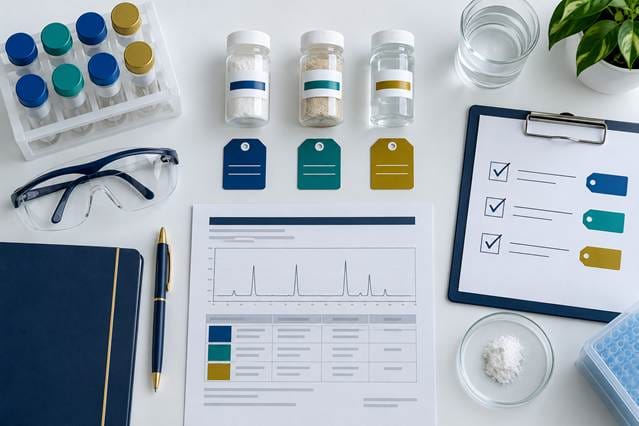
What a COA Cannot Prove
This is the section worth remembering. A COA reports the tests performed on the sample received. It does not stretch beyond that scope. Unless the report includes the relevant validated testing, it cannot establish all the following:
· That every unit sold under a name is identical to the tested sample
· That the material is sterile or free from endotoxins
· That storage and shipping conditions preserved the sample afterward
· That the product is FDA-approved or lawfully marketed for human use
· That the material is safe, effective or appropriate for any person
· That the stated amount is correct when quantity testing was not performed
FDA analytical guidance distinguishes uses such as identity, assay, purity and impurity testing because analytical procedures must be fit for their intended purpose. That principle is useful for consumers too: judge each result by the question the test was designed to answer.
Seven COA Red Flags
1. The report has no laboratory name or way to verify it.
2. The lot number is missing or does not match.
3. Only a cropped graph is shown without the complete report.
4. A purity percentage is presented as proof of quantity, sterility or safety.
5. The method is missing or described only as laboratory tested.
6. The report appears repeatedly across unrelated batches or products.
7. Questions about sample handling, dates or documentation receive vague answers.
A Simple Two Minute COA Check
1. Match the product name and lot number.
2. Identify the laboratory and report date.
3. List the exact tests performed.
4. Separate identity, purity and quantity results.
5. Confirm whether sterility or endotoxin testing is actually included.
6. Look for complete pages, methods and verification details.
7. Write down what the report does not answer.
COA FAQs
Does 99 percent purity mean the amount is correct?
No. Purity and quantity are different measurements. A separate assay or quantitative test may be needed to support the amount present.
Does HPLC prove identity?
HPLC can support identification under an appropriate method and reference comparison, but a purity chromatogram alone should not be treated as complete molecular confirmation.
Does mass spectrometry prove purity?
Not by itself. Mass spectrometry provides molecular information, while purity generally depends on a suitable separation and quantitation method.
Does third-party tested mean FDA-approved?
No. Independent testing and FDA approval are entirely different concepts. A COA does not change a product's regulatory status.
Should every COA include sterility testing?
That depends on the material and intended context. The important point is not to assume sterility unless the relevant testing is explicitly reported.
Can a COA be real but still misleading?
Yes. The document may be authentic while being outdated, incomplete, tied to another lot, or used to imply conclusions beyond the tests performed.
COA Talk Wrap Up
A strong COA is not about the biggest number on the page. It is about a clear match between sample, lot, laboratory, method and result. Identity, purity and quantity answer different questions. HPLC and mass spectrometry offer different kinds of evidence. Sterility and endotoxin status require their own testing.
Read the report for what it actually says, then pay equal attention to what it leaves unanswered. That habit turns a glossy document into something more useful: a starting point for informed questions.
Thanks for reading and keep lining up the facts before following the hype.
J
Research Resources
For independent HPLC peptide testing and publicly verifiable certificates, visit KMD Analytical peptide testing.
For an example of searchable third-party reports and lot-based documentation, visit VitalCore BioLabs testing and batch documentation.
Sources
· FDA Q2 R2 Validation of Analytical Procedures
· FDA Q7A Good Manufacturing Practice Guidance for Active Pharmaceutical Ingredients
· FDA Drug Quality Sampling and Testing Programs
· ICH Q6B Specifications for Biotechnological and Biological Products
· NCBI Bookshelf Biochemistry Peptide
Disclosure
Lifestyle Lineup is affiliated with VitalCore BioLabs. This article is educational and does not constitute medical advice or recommend the purchase, use or self-administration of any research product.