



Peptide Talk Is Everywhere. But What Are We Actually Talking About?
From skincare shelves and collagen powders to prescription medicine and buzzy wellness conversations, peptides have stepped into the spotlight. The tricky part is that the word peptide covers a very large family. Some peptides occur naturally in your body. Some are ingredients in food or cosmetics. Some are proven medicines prescribed for specific conditions. Others remain experimental, unapproved, or intended only for laboratory research.
That is why a smart peptide conversation begins with context, not hype. Let’s break it down in plain English, look at where the science is strongest, and build a better filter for the claims filling your feed.
THE QUICK TAKE: Peptides are short chains of amino acids. Their effects depend on their exact sequence, route, dose, manufacturing quality and whether they have actually been studied for a particular use. |
What Is a Peptide? Think Short Message, Specific Job
Amino acids are often called the building blocks of protein. Link a relatively short string of them together and you have a peptide. Link longer chains that fold into more complex shapes and you generally enter protein territory. The boundary is not perfectly rigid, but the simple picture works: peptides are small biological chains that can carry very specific instructions.
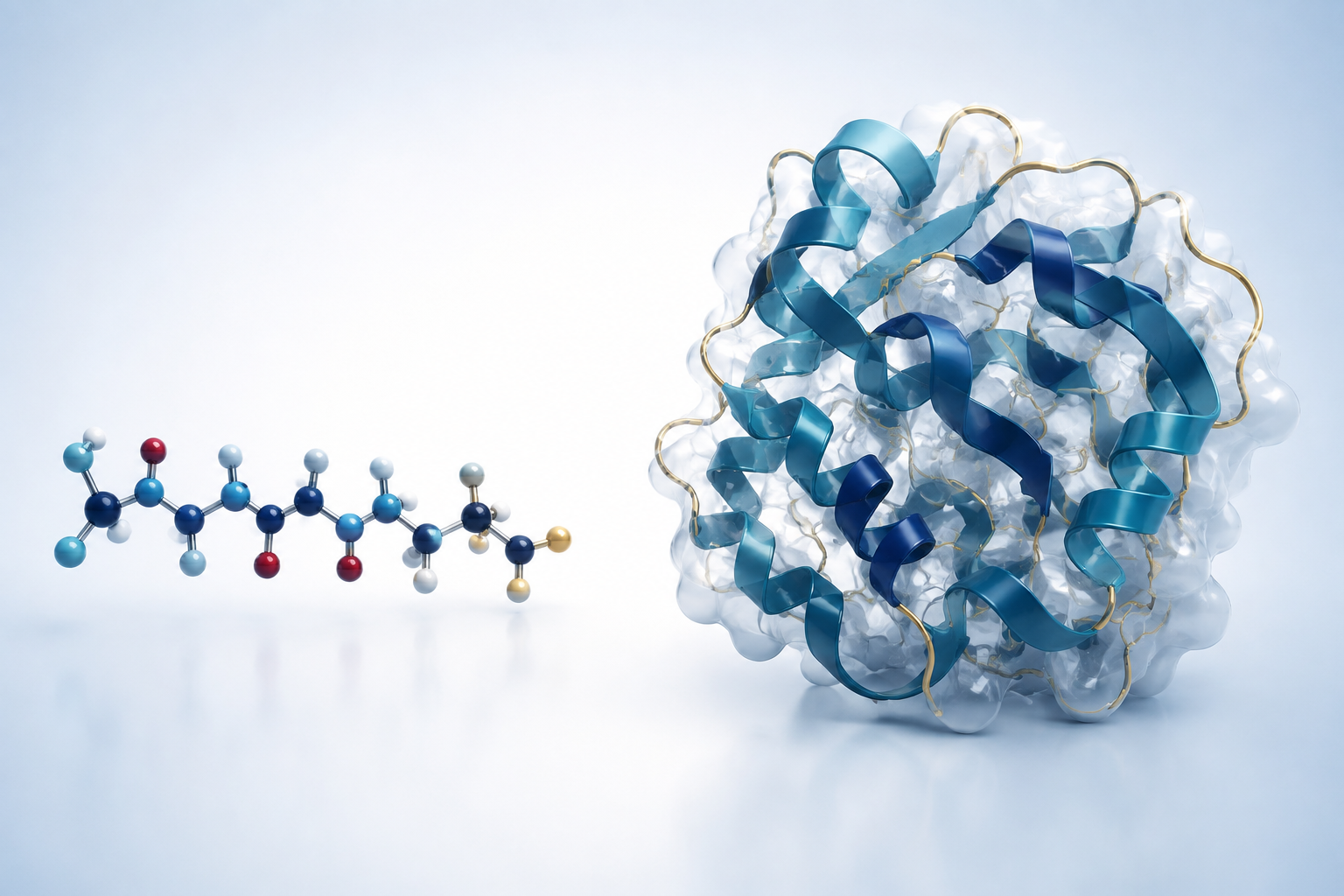
Your body already uses peptide signals throughout normal physiology. Depending on the peptide, those signals may be involved in metabolism, appetite, growth, immune activity, tissue communication and many other processes. That specificity is one reason peptide-based science is so compelling. It is also why you cannot assume that every peptide does the same thing, or that a result from one peptide applies to another.
The Four Peptide Lanes You Should Not Mix Up
1. Peptides Your Body Makes
Many peptides are natural signaling molecules. They help cells communicate and coordinate functions. Insulin, for example, is a peptide hormone. These natural roles help explain why researchers study synthetic or modified peptides as possible medicines.
2. FDA-Approved Peptide Medicines
Some peptide-based drugs have completed the FDA review process for defined medical uses. Approval is specific to a product, formulation, dose, population and indication. It does not turn the entire peptide category into an approved treatment, and it does not validate look-alike products sold online.
3. Food, Supplement and Cosmetic Peptides
Hydrolyzed collagen products contain smaller collagen peptides and are commonly sold as dietary supplements. Skincare formulas may feature peptides as topical ingredients. Evidence varies by ingredient, formulation and outcome. A promising study does not guarantee that every product on the shelf delivers the same result.
4. Investigational or Research Peptides
This is the lane that creates the most confusion. A compound may be discussed in early research, used in laboratory experiments, or studied in clinical trials without being FDA-approved for routine human use. A label such as “research use only” is not a safety certification, prescription, or green light for self-experimentation.
Why Peptides Have Become Such a Big Deal
Peptides are attractive to researchers because their structure can allow targeted biological activity. Depending on the molecule, that may create opportunities in areas such as metabolic disease, hormone signaling, immune regulation, dermatology and diagnostic research.
Outside the lab, interest tends to cluster around four headline goals:
Body composition and appetite support
Workout recovery and tissue health
Skin appearance and healthy aging
Sleep, focus and general performance
These are areas of interest, not a blanket list of proven benefits. The quality of evidence ranges from established prescription uses to small studies, animal research, preliminary findings and pure marketing. The name of a peptide is never enough. You need to ask what was studied, in whom, by what route, at what dose, and with what outcome.
Evidence Check: Promising Is Not the Same as Proven
A compelling mechanism can make a peptide sound inevitable: it interacts with receptor X, which influences pathway Y, so surely it must produce result Z. Biology is rarely that tidy. Human outcomes can differ from test-tube or animal findings, and early trials may be too small or too short to reveal the full benefit-and-risk picture.
A stronger evidence trail usually moves from laboratory work to animal studies, then carefully controlled human trials, independent replication, and ongoing safety monitoring. Look for meaningful outcomes, not just a change in a laboratory marker.
SMART READER RULE: Treat words such as may, could and promising as invitations to keep reading, not as proof that a product works. |
Quality Matters: Purity Is Important, but It Is Not the Whole Story
Online peptide conversations often revolve around a single purity percentage. That number can be useful, but it cannot answer every quality question. Identity, quantity, impurities, sterility, endotoxins, storage, stability, packaging and chain of custody may all matter depending on the product and intended setting.

Analytical tools such as high-performance liquid chromatography and mass spectrometry can help evaluate identity and composition. Even so, a certificate of analysis is only as trustworthy as the sample, laboratory, methods and documentation behind it. A report does not convert an unapproved product into an approved medicine, and it does not establish clinical safety or effectiveness.
A Better Quality Checklist
Is the product clearly identified, with a matching lot or batch number?
Is the testing laboratory named, and are the methods and results understandable?
Does the documentation address identity and amount, not purity alone?
Are claims careful and consistent with the product’s legal and regulatory status?
For medical treatment, is a licensed clinician and legitimate pharmacy involved?
Approved, Compounded and Unapproved: Three Different Things
An FDA-approved drug has been reviewed for safety, effectiveness and quality for its approved use. A compounded drug is prepared for an individual medical need under applicable law, but compounded drugs are not FDA-approved. The FDA does not review them for safety, effectiveness or quality before marketing. Compounding can serve legitimate needs, but poor quality or contamination can cause serious harm.
An unapproved product sold directly to consumers is another category entirely. Online availability, polished packaging, influencer attention or a laboratory report should never be mistaken for regulatory approval. If a peptide is being considered as medical treatment, the practical starting point is a qualified health professional who can discuss approved options, interactions, contraindications and monitoring.
Red Flags That Should Stop You Mid-Scroll
One peptide is promoted as fixing nearly everything.
The seller promises guaranteed fat loss, healing, anti-aging or muscle growth.
Before-and-after photos replace transparent human clinical evidence.
There is no clear distinction between approved medicine and research material.
The company discourages questions about testing, sourcing, storage or lot traceability.
A “not for human use” label sits beside detailed instructions for personal use.
BOTTOM LINE: Good science welcomes specific questions. Hype tries to rush you past them. |

Top Peptide FAQs
Are all peptides drugs?
No. Peptides occur naturally in the body and appear in foods, supplements, cosmetics, approved medicines and research settings. The category alone does not determine legal status or effectiveness.
Are collagen peptides the same as injectable peptides?
No. Collagen peptides are typically consumed as a food-derived supplement. Injectable peptide products involve different molecules, manufacturing requirements, risks and regulatory considerations.
Does a high purity result prove a peptide is safe?
No. Purity is one piece of analytical information. It does not by itself prove correct identity, dose, sterility, stability, safety or clinical effectiveness.
Does “research use only” mean pharmaceutical grade?
No. The phrase generally signals that a material is intended for laboratory research rather than human use. It is not an FDA quality designation.
Can a compounded peptide be FDA-approved?
Compounded drugs are not FDA-approved, even when a prescriber determines that compounding is medically appropriate for a particular patient.
What is the smartest first question to ask?
Ask what regulatory category the exact product falls into and what human evidence supports the exact claim being made.
Peptide Talk Wrap-Up
Peptides deserve attention. They are already central to human biology, established medicines and exciting areas of research. But they also deserve precision. “Peptide” is not a shortcut for safe, effective or approved.
The winning approach is simple: know which lane you are in, judge evidence by its quality, take manufacturing and testing seriously, and keep medical decisions between you and a qualified professional. Curiosity is a great start. Careful questions are what turn curiosity into informed choices.
Thanks for reading, and keep lining up the facts before following the hype.
J
Sources and Further Reading
- Biochemistry, Peptide — National Center for Biotechnology Information
- Amino Acids — MedlinePlus and the National Library of Medicine
- Understanding the Risks of Compounded Drugs — U.S. Food and Drug Administration
- Bulk Drug Substances Used in Compounding — U.S. Food and Drug Administration
- Dietary Supplements for Exercise and Athletic Performance — National Institutes of Health Office of Dietary Supplements