

Few research peptides have attracted as much attention for tissue repair as BPC-157.
Its appeal is easy to understand. Across laboratory and animal studies, BPC-157 has been connected with tendon and muscle healing, collagen organization, blood-vessel signaling, gastrointestinal protection and inflammatory balance. Instead of targeting only one narrow pathway, it appears to influence several stages of the repair process.
That makes BPC-157 one of the more intriguing experimental peptides in regenerative research. It also makes careful language important. The preclinical findings are broad and often impressive, but controlled human evidence remains very limited.
The strongest case for BPC-157 is not that every popular claim has been proven. It is that a consistent group of laboratory findings points toward a peptide with unusual research potential across multiple tissue systems.
What Is BPC-157?
BPC-157 is a synthetic chain of 15 amino acids. Its name is commonly expanded as Body Protection Compound 157, and the sequence is associated with research involving a protective protein found in gastric juice.
Because it contains 15 amino acids, BPC-157 is classified as a pentadecapeptide. Its compact structure and reported stability in experimental conditions have helped make it a frequent subject of research involving connective tissue and the gastrointestinal tract.
| Reference point | BPC-157 |
|---|---|
| Compound type | Synthetic pentadecapeptide |
| Length | 15 amino acids |
| Sequence | GEPPPGKPADDAGLV |
| CAS number | 137525-51-0 |
| Molecular formula | C62H98N16O22 |
| Molecular weight | Approximately 1,419.5 g/mol |
| Primary research areas | Connective tissue, gastrointestinal protection, vascular signaling and inflammation |
Why Researchers Are So Interested in BPC-157
1. Tendon and Ligament Repair
Tendons and ligaments heal slowly because they receive less blood flow than many other tissues. Their repair also requires fibroblasts to migrate into the damaged area and organize new collagen in the correct direction.
Laboratory studies suggest BPC-157 may support several pieces of that process. Research has reported increased tendon-fibroblast migration, survival and spreading, along with activity involving focal adhesion kinase and paxillin. These proteins help cells attach to their surroundings and move through a tissue matrix.
Animal studies have also described improved tendon structure, mechanical strength and tendon-to-bone healing. A 2025 systematic review examining 36 studies found positive outcomes across muscle, tendon, ligament and bone injury models, which is one reason sports-medicine researchers continue to watch the field closely.
2. Muscle Recovery Models
BPC-157 has produced encouraging results in experimental models of crushed, cut and otherwise damaged muscle. Researchers have reported improvements in muscle organization, functional recovery and healing, including models in which corticosteroids would normally impair the repair process.
This does not prove the same outcome in people. It does show that the research extends beyond one injury model or one tissue type. BPC-157 appears to interact with broader repair signaling rather than acting only on a single structure.
3. Blood-Vessel and Nitric-Oxide Signaling
Damaged tissue needs an adequate blood supply. New and repaired vessels deliver oxygen, nutrients and signaling molecules while helping remove metabolic waste.
Preclinical research links BPC-157 with angiogenic signaling and the nitric-oxide system. Studies have reported activity involving VEGFR2, Akt and eNOS pathways, along with improved blood-flow recovery and increased vessel formation in animal models.
The important idea is not simply “more blood vessels.” Successful repair requires appropriately controlled vessel growth that develops alongside collagen remodeling and cellular migration. BPC-157 is compelling because experimental findings suggest it may influence this coordinated environment.
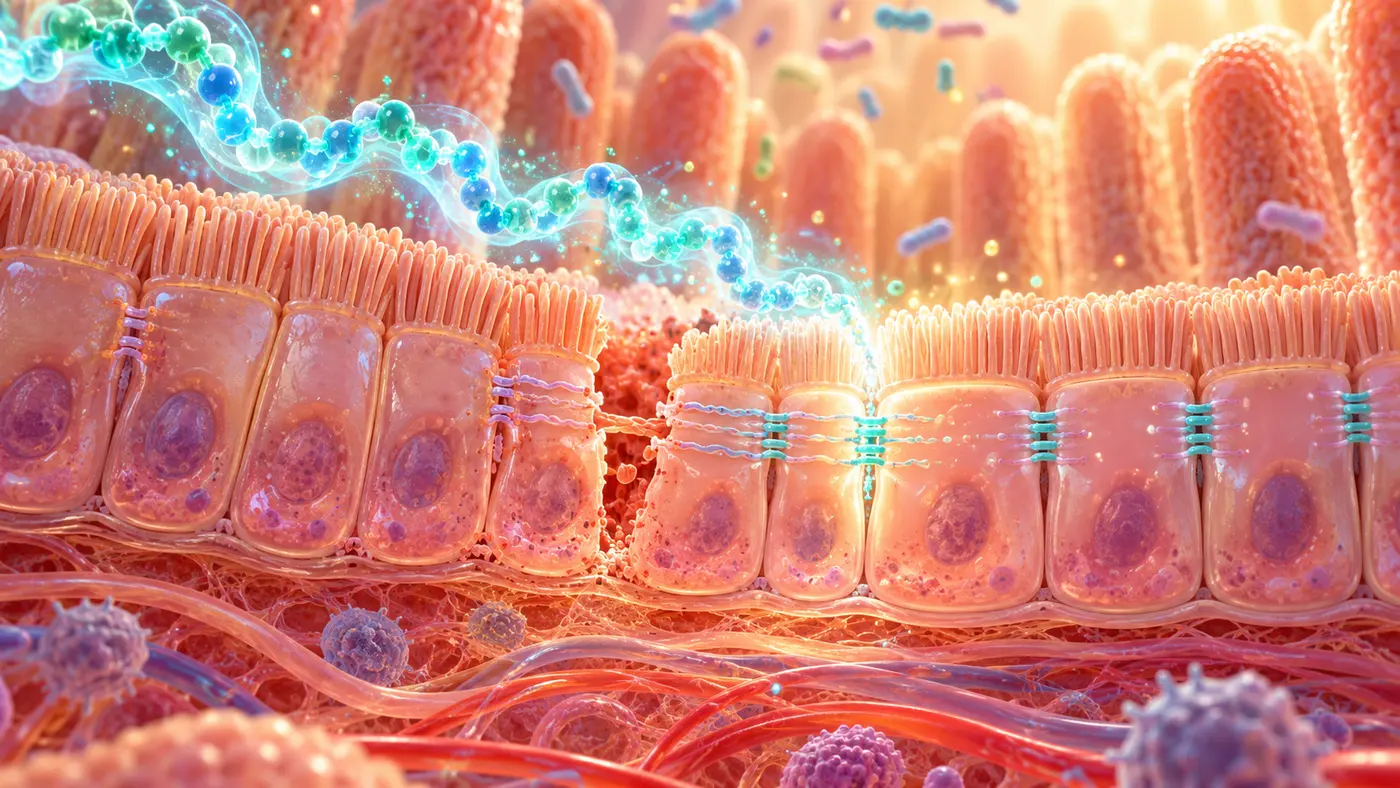
4. Gastrointestinal Barrier Research
BPC-157 research began with a strong gastrointestinal focus. Experimental studies have examined ulcers, intestinal injury, inflammatory damage, fistulas and surgical connections between sections of the digestive tract.
Across many animal models, researchers have reported improved mucosal protection, tissue continuity and healing. This broad gastrointestinal history gives BPC-157 a different research profile from peptides studied mainly for muscle or metabolic effects.
Its apparent activity in the digestive environment has also contributed to interest in how peptide stability, epithelial signaling and blood-vessel responses may work together at tissue barriers.
5. Inflammatory Balance
Inflammation is necessary at the beginning of healing. The problem comes when the response becomes excessive, prolonged or poorly coordinated.
BPC-157 studies have reported changes in inflammatory signaling and oxidative-stress markers across several experimental injury models. The potential advantage is not the elimination of inflammation. It is the possibility of supporting a more controlled transition from the inflammatory stage into rebuilding and remodeling.
The Pros: Why the Research Is Exciting
| Research advantage | Why it matters |
|---|---|
| Multiple tissue models | Positive findings appear across tendon, ligament, muscle, bone, skin and gastrointestinal research. |
| Several repair stages | The peptide has been connected with cell migration, collagen organization, vascular signaling and inflammatory balance. |
| Consistent preclinical direction | Different research groups and injury models frequently report improved structural or functional measures. |
| Gastrointestinal stability interest | Its origins and experimental behavior have made it especially interesting for tissue-barrier and oral-delivery research. |
| Potential under difficult conditions | Some models report positive effects even when healing is impaired by corticosteroids or severe tissue damage. |
| Mechanistic depth | The literature explores specific pathways rather than relying only on general observations of recovery. |
The biggest pro: BPC-157 does not look interesting because of one isolated experiment. It looks interesting because many preclinical models point toward coordinated activity across multiple parts of the repair process.
What Human Evidence Exists?
Human evidence is beginning to appear, but it remains far too small for firm conclusions.
A retrospective report involving knee injections described improvement in many participants, but it lacked the controls, randomization and standardized methods needed to establish effectiveness. A published pilot study of intravenous BPC-157 involved only two adults. That study did not identify major short-term safety changes in the limited measurements collected, but two participants cannot establish general safety.
These reports are worth noting because they show that human investigation has started. They should not be treated as the equivalent of a large, blinded, placebo-controlled trial.

The Counterbalance: What Has Not Been Proven
The case for continued research is strong. The case for certainty in humans is not.
- Most published benefits come from cells and animals. Those models help identify mechanisms, but they do not guarantee the same magnitude of effect in people.
- Human safety remains under characterized. Long-term immune, cardiovascular, reproductive and cancer-related risks have not been established through large clinical trials.
- Product quality can vary. Peptide identity, purity, aggregation, counterions and contaminants all matter, especially when products come from unregulated sources.
- Regulatory acceptance is unresolved. BPC-157 is not an FDA-approved drug. FDA has placed BPC-157-related bulk substances in a category associated with potential significant safety risks during compounding review.
- Tested athletes need special caution. The 2026 World Anti-Doping Agency list names BPC-157 under non-approved substances prohibited at all times.
These limitations do not erase the positive research. They define what the next stage of research must accomplish.
How to Evaluate BPC-157 Research Material
A label stating “high purity” is not enough to establish research quality. A serious listing should provide documentation tied to the actual lot.
Look for:
- The complete compound name and stated salt or counterion form
- A lot number that matches the vial and analytical report
- Identity confirmation in addition to a purity percentage
- A complete chromatogram and analytical method where appropriate
- The name of the testing laboratory and the test date
- Clear storage and handling information
- Separate sterility and endotoxin documentation whenever sterile research is claimed
Purity, identity, sterility and endotoxin control answer different questions. One result cannot substitute for all the others.
So, Is BPC-157 Worth Watching?
From a research standpoint, absolutely.
BPC-157 has one of the broadest and most consistently positive preclinical profiles among emerging repair-focused peptides. Its potential influence on fibroblast activity, collagen organization, vascular signaling, muscle recovery and gastrointestinal protection gives researchers several credible reasons to keep investigating it.
The remaining gap is human proof. Larger controlled trials must determine whether the promising mechanisms produce meaningful outcomes, which formulations and routes are most reliable, and what short-term and long-term risks may exist.
That is the balanced conclusion: BPC-157 is not proven medicine, but it is far more than an empty research trend. It is a biologically interesting peptide with a substantial experimental record and a strong case for better clinical research.
Frequently Asked Questions
What does BPC-157 stand for?
BPC is commonly expanded as Body Protection Compound. The number 157 identifies the 15-amino-acid peptide sequence studied in this research line.
Is BPC-157 a peptide?
Yes. It is a synthetic pentadecapeptide composed of 15 amino acids.
What benefits are researchers studying?
Major research areas include tendon, ligament and muscle repair; collagen and fibroblast activity; gastrointestinal protection; blood-vessel signaling; and inflammatory regulation.
Has BPC-157 been proven effective in humans?
No. Human reports are limited and methodologically weak. The strongest evidence remains preclinical.
Is BPC-157 FDA approved?
No. BPC-157 is not approved by the FDA for treating any disease or injury.
Is BPC-157 prohibited in tested sports?
Yes. The 2026 WADA Prohibited List includes BPC-157 as a non-approved substance prohibited at all times.
This article is for educational purposes only. It does not provide medical advice or recommend the use of BPC-157. Research compounds are not intended for human consumption, diagnosis, treatment or prevention of disease.
Sources
- Emerging Use of BPC-157 in Orthopaedic Sports Medicine: A Systematic Review
- Regeneration or Risk? A Narrative Review of BPC-157 for Musculoskeletal Healing
- BPC-157 and Tendon Fibroblast Growth and Migration
- Therapeutic Potential of Pro-Angiogenic BPC-157
- Intra-Articular BPC-157 for Multiple Types of Knee Pain
- Safety of Intravenous BPC-157 in Humans: A Pilot Study
- PubChem: BPC-157
- FDA: Bulk Substances That May Present Significant Safety Risks
- World Anti-Doping Agency: 2026 Prohibited List