


A peptide produces an interesting result in a dish. Then it shows a promising signal in an animal study. Online, the story can quickly become: “It works.”
But those three words can hide a very large gap.
Scientific evidence develops in stages. Each stage answers a different question, under different conditions, with different limits. A result in cultured cells may reveal a biological mechanism. An animal model may show how that mechanism behaves in a living system. A human trial must then determine whether the same idea is relevant, measurable and acceptably safe in people.
The later stages do not simply confirm the earlier ones. They often expose complications that the simpler models could not show.
Understanding that evidence gap is one of the best ways to separate a promising research lead from a claim that has moved too far ahead of the science.
One Result Can Have Three Different Meanings
When people say a peptide has been “studied,” the word may refer to anything from a single laboratory experiment to multiple controlled human trials. Those are not interchangeable levels of evidence.
A laboratory study might show that a peptide changes a signaling pathway in a specific type of cell. That finding can be real and important. It still does not establish what happens when the compound enters a complete biological system with digestion, circulation, metabolism, immune responses and many interacting tissues.
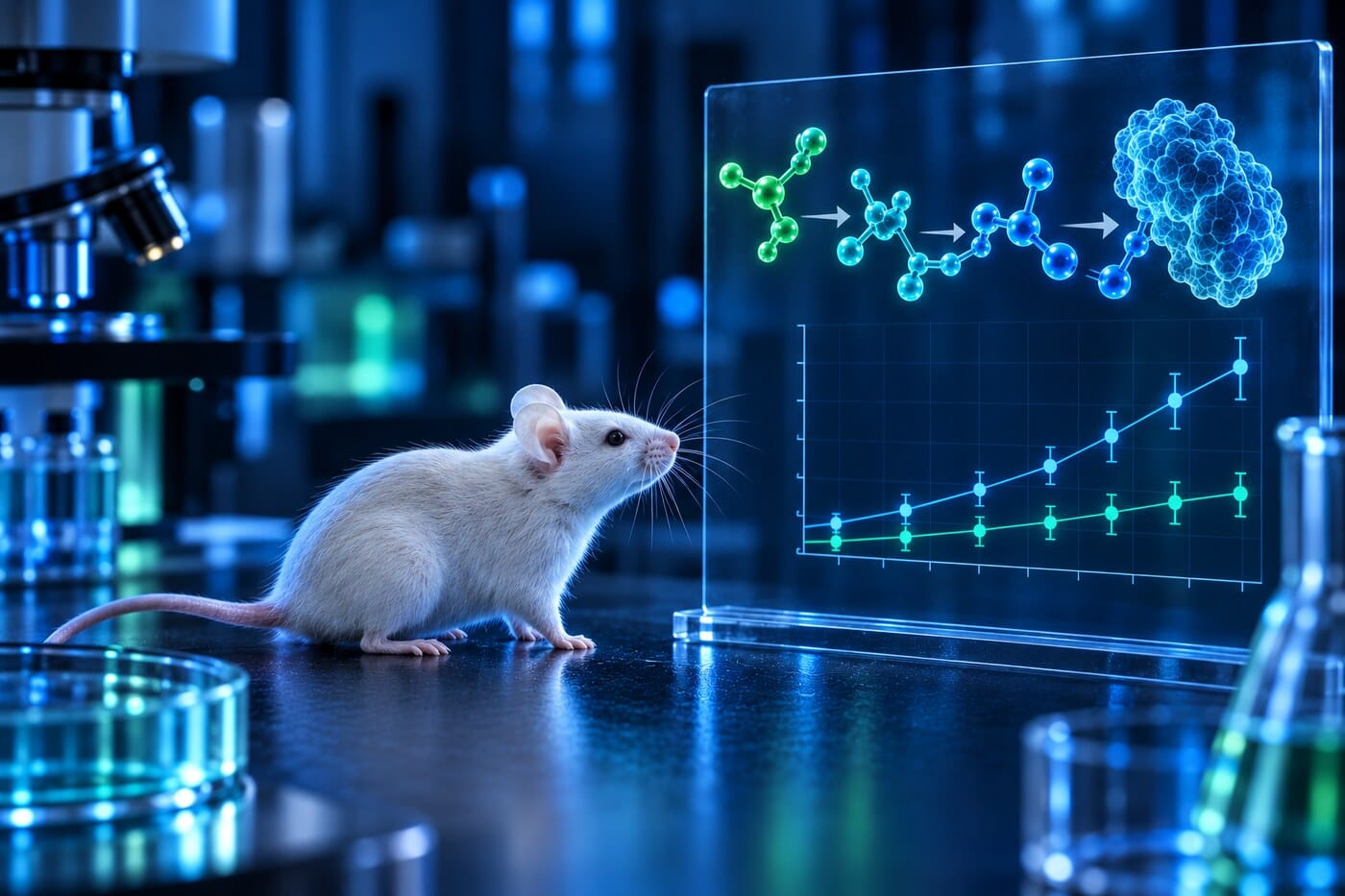
An animal study adds some of that complexity. Yet a mouse, rat or other model is not a small human. Species can differ in receptor biology, metabolism, disease progression and the way an experimental injury is created. A finding may translate well, partly or not at all.
Human research adds another layer: variation in age, health, genetics, medications, environment and behavior. It also has to address outcomes that actually matter to people, not only laboratory markers.
The Peptide Evidence Ladder
Research is often described as a ladder, but it is better pictured as a series of filters. At every stage, a question becomes more realistic and the standard for the claim becomes higher.
| Evidence stage | What it can help show | What it cannot establish alone |
|---|---|---|
| In vitro research | Cellular activity, receptor binding and possible mechanisms | Whole-body effects, human safety or meaningful clinical benefit |
| Animal research | Behavior in a living system, biological distribution and early safety signals | Reliable human outcomes or a complete human safety profile |
| Early human research | Initial tolerability, exposure and preliminary signals | Broad effectiveness, long-term safety or results across populations |
| Controlled and replicated human studies | More reliable estimates of benefits, risks and limitations | Certainty for every person, setting or future use |
In Vitro: Controlled but Incomplete
In vitro research takes place outside a living organism, often using isolated cells, tissues or biochemical systems. It gives researchers unusually tight control. They can choose the cell type, concentration, exposure time and measurement, then observe a response with fewer competing variables.
That control is both the strength and the limitation. A concentration that produces a clear effect in a dish may never be achievable, stable or relevant in a living system. Cells removed from their normal environment also lose signals from other tissues, hormones, blood flow and the immune system.
An in vitro result can support the statement, “This peptide affected these cells under these conditions.” It cannot support the broader conclusion, “This peptide produces the same effect in people.”

Animal Models: A Living System, Not a Final Answer
Animal models can show how a compound behaves across organs and tissues. Researchers can study absorption, distribution, metabolism, toxicity and biological responses that cannot be recreated fully in a dish.
The FDA describes in vitro and in vivo work as the two main forms of preclinical research. These studies help researchers evaluate toxicity and decide whether a candidate should advance to testing in people. That decision is a gateway to further research, not proof of a human result.
The quality of an animal study also matters. Was the model appropriate for the question? Were animals assigned randomly? Were outcome assessors blinded? Was the sample large enough? Were both positive and negative findings reported? Guidelines such as ARRIVE 2.0 exist to improve the design and reporting of animal research because missing details can make a study difficult to interpret or repeat.
Human Studies: The Question Becomes More Specific
Human research is not one single level. An early study may focus mainly on tolerability or how the body handles a compound. A small pilot may look for a preliminary signal. A randomized controlled trial is designed to compare outcomes while reducing bias. Replication asks whether the result appears again in new data.
The details determine what the study can support. A trial involving a narrow group over a short period may not reveal long-term effects or apply to a broader population. A statistically significant change in a laboratory marker may not produce a meaningful change in how people feel or function.
This is why “human study” should start a conversation, not end one.

Why Promising Results Sometimes Fade
When a finding weakens at a later stage, it does not always mean the earlier study was wrong. It may mean the original result was true only under a specific set of conditions.
Biology Changes With the Model
Receptors may differ between species. Enzymes may break down a peptide at different rates. A laboratory model may reproduce one feature of a condition while missing others. The immune system can also change a response in ways an isolated cell experiment cannot predict.
Exposure Is Not the Same as Activity
A compound must remain intact long enough to reach the relevant tissue at an appropriate concentration. A strong cellular response does not answer whether the compound can survive, circulate, enter the target tissue or remain active there.
The Endpoint May Be Too Narrow
Researchers often measure a biomarker because it is faster or easier to detect than a long-term outcome. Biomarkers can be useful, but movement in a marker does not always lead to a practical benefit. The connection between the marker and the claimed outcome must itself be supported.
Small Studies Can Magnify Noise
Small exploratory studies are useful for finding signals worth pursuing. They are also more vulnerable to chance, unusual samples and exaggerated estimates. A dramatic result from one study should become a reason for confirmation, not a reason to skip it.
Reproducibility Changes Confidence
The National Institutes of Health identifies rigorous design and reproducibility as cornerstones of scientific progress. A result becomes more convincing when researchers can repeat it, when independent groups find something similar and when methods are reported clearly enough to evaluate.
Reproducibility and replication are related but different. Reproducibility generally asks whether the same data and methods can produce the same analysis. Replication asks whether a new study collecting new data reaches a consistent conclusion.
Neither process guarantees absolute truth. Together, they help expose findings that depend on a hidden choice, a narrow model or a chance pattern.

Product Testing and Biological Evidence Are Different
Independent analytical testing can answer important product questions. Does a sample contain the expected compound? What is its chromatographic purity? How much material is present? Does the report match the lot being evaluated?
Those answers support identity and quality assessment. They do not establish how the compound behaves in cells, animals or people. A strong certificate of analysis cannot turn preclinical evidence into clinical evidence.
Likewise, an exciting published study cannot verify the identity or purity of a vial. The research and the material are two separate evidence problems, and both deserve attention.
Independent laboratories such as KMD Analytical can provide third-party identity, purity and net-content testing. For help understanding what a test report actually shows, read How to Read a Peptide COA and Beyond 99%: What Peptide Purity Does Not Tell You.
Five FAQs About a Peptide Claim
Before accepting a headline, product description or social-media summary, ask five simple questions:
- What was actually studied? Was it an isolated cell, an animal model or a group of people?
- What outcome was measured? Was it a molecular signal, a biomarker or a meaningful functional result?
- How was the study designed? Look for controls, randomization, blinding, adequate sample size and clearly defined endpoints.
- Has anyone repeated it? One exciting result carries less weight than consistent findings across independent studies.
- Does the claim match the evidence level? Mechanism language should not be rewritten as a promise of human benefit.
These questions also apply to combinations. Our previous article, Peptide Stacking: Signal or Noise?, explains why adding more compounds also adds more uncertainty.
The Bottom Line
Cell studies, animal studies and human trials all matter. The mistake is treating them as though they answer the same question.
Early research identifies possibilities. Preclinical research tests those possibilities in more complex systems. Human research determines whether a specific use produces a measurable result with an acceptable risk profile. Replication and transparent reporting then help show whether the conclusion can hold up.
A promising result should create curiosity, not certainty. The most trustworthy interpretation stays at the level the evidence has actually reached.
Sources
- FDA: Step 2, Preclinical Research
- NIH: Enhancing Reproducibility Through Rigor and Transparency
- National Academies: Reproducibility and Replicability in Science
- ARRIVE Guidelines 2.0
Research-use notice: This article is for educational and informational purposes only. It does not provide medical advice, recommend peptide use or present any compound as safe or effective for human consumption. Products discussed in this context may be intended for laboratory research only.
For research-use-only materials and educational resources, visit VitalCore BioLabs.