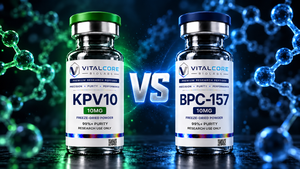


One peptide can raise a long list of questions. Two or three can multiply them.
That is the tension behind peptide stacking, a casual term for using or studying more than one peptide at the same time. Online, a stack may be presented as a smart combination built around a shared goal. In a laboratory, however, a combination is not automatically better, stronger or more advanced. It is simply a new experiment—one with more variables, more possible interactions and a higher burden of proof.
This distinction matters because much of the peptide conversation moves faster than the evidence. A compound may have an interesting biological mechanism. Another may show a promising signal in cells or animals. Putting the two together can sound logical, but logic alone cannot establish what the combination will do.
The real question is not whether two peptides could complement each other. It is whether a well-designed study has shown that they actually do.
What Peptide Stacking Actually Means
Peptide stacking generally means combining two or more peptides within the same research plan or period of use. The word itself is informal. It does not describe a recognized level of evidence, a standard formulation or an approved medical strategy.
The compounds in a proposed stack may be grouped because they are thought to affect related processes, such as inflammatory signaling, tissue repair, metabolism or immune activity. In other cases, they may be combined because people believe they act through different pathways that could support the same broad objective.
That creates a plausible story. It does not create a proven outcome.
Laboratory Combinations vs. Online Stacks
In controlled research, investigators define the compounds, doses, timing, test system and endpoints before interpreting a result. They also include comparison groups so they can separate the effect of compound A, compound B and the combination.
An online stack is often described in the opposite direction: a desired outcome comes first, then compounds are assembled around it. The explanation may lean on mechanisms, anecdotes or results from separate studies. That approach can make a combination sound more certain than the underlying science supports.

Why Researchers Combine Compounds
Combination research is not unusual. Scientists combine agents to ask whether different mechanisms can work together, whether one changes the response to another or whether a lower exposure to each can produce a measurable effect. These are testable questions—not promises.
Complementary Pathways
Two compounds may influence different points in the same biological process. One might affect a signaling molecule near the beginning of a pathway while another influences a later cellular response. Researchers may hypothesize that targeting both points will produce a broader or more durable effect.
But biology is rarely a straight line. Pathways overlap, feedback loops turn signals up or down, and the same molecule can behave differently across tissues or experimental conditions. A pairing that looks complementary on paper may be redundant, ineffective or disruptive in practice.
Testing the Combination Against Its Parts
The only clean way to evaluate a two-compound combination is to compare it with its components. If researchers examine only the combination, they cannot tell whether one compound produced the entire result, whether both contributed or whether the same outcome would have occurred without either one.
That is why a combination claim should make you ask: Were the individual compounds studied under the same conditions? Was there a control group? Was the combined effect meaningfully different?
Four Outcomes a Combination Can Produce
A stack can create several different patterns. More compounds do not guarantee more effect.
| Possible outcome | What it means | Why it matters |
|---|---|---|
| Additive | The combined response is roughly what researchers would expect from adding the individual effects. | Both compounds may contribute, but the combination is not uniquely powerful. |
| Synergistic | The combined response exceeds the expected result from the individual compounds. | This is often the hoped-for finding, but it must be demonstrated—not assumed. |
| Antagonistic or interfering | One compound reduces, changes or complicates the effect of the other. | A reasonable-sounding pairing can perform worse than a single compound. |
| No added effect | The combination does not improve the measured result over one compound alone. | Extra complexity may add no measurable benefit. |

This is where the language around stacking can become misleading. “Works through a different pathway” does not mean “works better together.” Even genuine synergy in one model would not automatically establish safety, effectiveness or relevance in people.
Why More Compounds Can Weaken the Evidence
A single-compound study already has to account for identity, purity, concentration, stability, handling, dose, timing and measurement. Add a second peptide, and each of those variables can expand. Add a third, and the number of possible relationships grows again.
Attribution Becomes Harder
If a change occurs after several compounds are introduced at once, it is difficult to identify the cause. Was it compound A, compound B, their interaction, an impurity or an unrelated variable? Without individual comparison groups, the experiment may produce an observation but little explanation.
This problem is especially important when outcomes are subjective or when many changes happen at the same time. A compelling personal account may be sincere, yet still be unable to establish cause and effect.
Quality Variables Multiply
Peptide research products can differ in identity, purity, quantity, residual solvents, sterility and endotoxin status. Each additional vial introduces another lot, another manufacturing history and another opportunity for a labeling or quality problem.
A certificate of analysis can help document certain attributes of one tested lot, but it cannot predict how two compounds will interact. It also cannot replace an appropriately designed study. For a practical explanation of what testing can—and cannot—show, see our guide, Beyond 99%: What Peptide Purity Does Not Tell You.
What a Well-Designed Combination Study Looks Like
For a basic two-compound experiment, the clearest design usually includes at least four groups:
- A control group
- Compound A alone
- Compound B alone
- Compounds A and B together
The groups should be evaluated using the same model, schedule, endpoints and analytical methods. Randomization and blinded outcome assessment can reduce bias. Researchers should also define what would count as an additive, synergistic or antagonistic result before looking at the data.

The details matter. If the single compounds are tested at different times, in different models or with different measurements, the comparison becomes weaker. Separate studies can generate a hypothesis about a stack, but they usually cannot validate the stack itself.
A Current Research Example
A 2026 animal study offers a useful example of why combinations need direct testing. Researchers studied BPC-157 and TB-500 in a rat model of Achilles tendon injury. The 32 rats were divided into four groups: control, BPC-157, TB-500 and a combination group.
The investigators reported favorable findings for the individual treatment groups in certain histological and biomechanical measures. However, the combination did not provide an additional benefit compared with either agent alone. In other words, combining two compounds that each generated interest did not automatically produce a superior result.
The study is exploratory, involved animals rather than people and does not establish clinical safety or effectiveness. Its value here is conceptual: the combination had to be tested against its parts, and the result challenged the simple assumption that more would be better.
Testing and Traceability Matter Even More in a Stack
Before interpreting any experiment, researchers need confidence that the materials are what their labels claim. Lot-specific analytical testing can help examine identity, purity and quantity. Depending on the intended research, additional testing may evaluate sterility, endotoxins, residual solvents or other quality attributes.
Independent laboratories such as KMD Analytical can provide third-party peptide identity, purity and net-content testing. The presence of a lab report, however, should never be treated as proof that a multi-compound combination is safe or effective. Testing describes selected characteristics of a sample; it does not validate a biological claim.

Traceability also matters. A useful record connects the vial to a specific lot number and connects that lot to the report being shown. A generic certificate, a cropped screenshot or a report with no verifiable match offers far less confidence. Our straight-talk peptide guide explains why evidence level and product quality should be evaluated separately.
What Researchers Can Honestly Conclude
The strongest conclusion should match the strongest available evidence. A cell study can show what happened in that cell model. An animal study can show what happened in that species under those conditions. Neither automatically establishes what will happen in a person.
Interesting Is Not Established
A thoughtful combination hypothesis can be scientifically interesting. It may deserve testing. But the language should remain precise until replicated evidence supports something stronger.
Watch for claims that jump from mechanism to outcome, combine findings from unrelated studies or treat testimonials as confirmation. Also be cautious when a seller describes a stack as “synergistic” without a controlled comparison demonstrating synergy.
The most honest language often sounds less exciting: proposed, observed in a model, not yet established, or requires further study. That restraint is a sign of evidence awareness—not a lack of confidence.
The Bottom Line
Peptide stacking is best understood as a combination research question, not a shortcut to a better result. Two promising compounds may act additively, synergistically, independently or against each other. They may also introduce quality and interpretation problems that do not exist in a single-compound experiment.
The smarter question is not “What belongs in the stack?” It is “What evidence isolates the effect of the combination?”
Until controlled research supplies that answer, a plausible stack remains a hypothesis.
Sources
- FDA: Certain Bulk Drug Substances for Use in Compounding May Present Significant Safety Risks
- FDA Pharmacy Compounding Advisory Committee materials on BPC-157 and TB-500
- Effects of BPC-157 and TB-500 on Achilles Tendon Healing in Rats: A Histopathological and Biomechanical Study
- BPC-157 Systematic Review
Research-use notice: This article is for educational and informational purposes only. It does not provide medical advice, recommend peptide use or present any compound as safe or effective for human consumption. Products discussed in this context may be intended for laboratory research only.
For research-use-only materials and educational resources, visit VitalCore BioLabs.